Automating a form-heavy process
The information is typed once. It then fills in four forms that have nothing in common.
- The file goes out complete: documents generated and attached, nothing missing
- Everything is logged: what went out, when, and whether it went through
Before and after
The starting point
In many companies, someone spends their days copying. They take a piece of information from an email or a spreadsheet. They retype it into an online form. Then into another one, with different fields.
Supplier portal, filing interface, customer platform: each one has its own rules and attachments.
This work has three flaws. It is slow. It produces typos nobody notices until a complaint comes in. And three weeks later, nobody knows what was sent, or when.
What was put in place
Collect
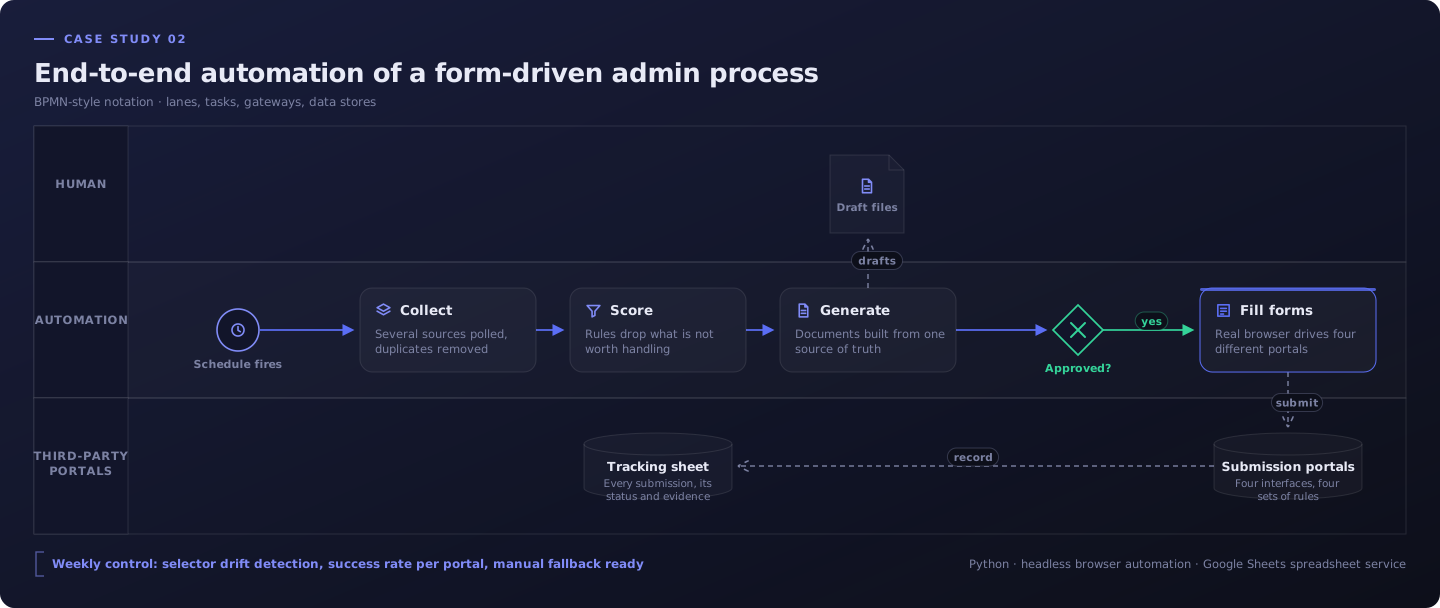
First, go and fetch instead of waiting. Sources are checked automatically. Duplicates are discarded. Simple rules drop what is not worth processing. Volume goes down before a human even looks.
Generate
Then, generate instead of copying. Documents are produced from a single source. The information is typed only once, at the start.
Fill in and prove
Finally, fill in and prove. A browser fills in the forms of the four platforms, each with its quirks. Nothing goes out without approval. Every submission is logged, with its status and its proof.
You stay in controlNothing goes out without approval. Every submission is logged, with its status and its proof.
What it taught us
A form does not need an API to be automated. If a human can fill it in, so can a machine.
What breaks is the day the platform changes its form. Without monitoring, the automation stops silently. That is why the success rate is checked every week, platform by platform.
How it works