Customer journey redesign and CRM activation
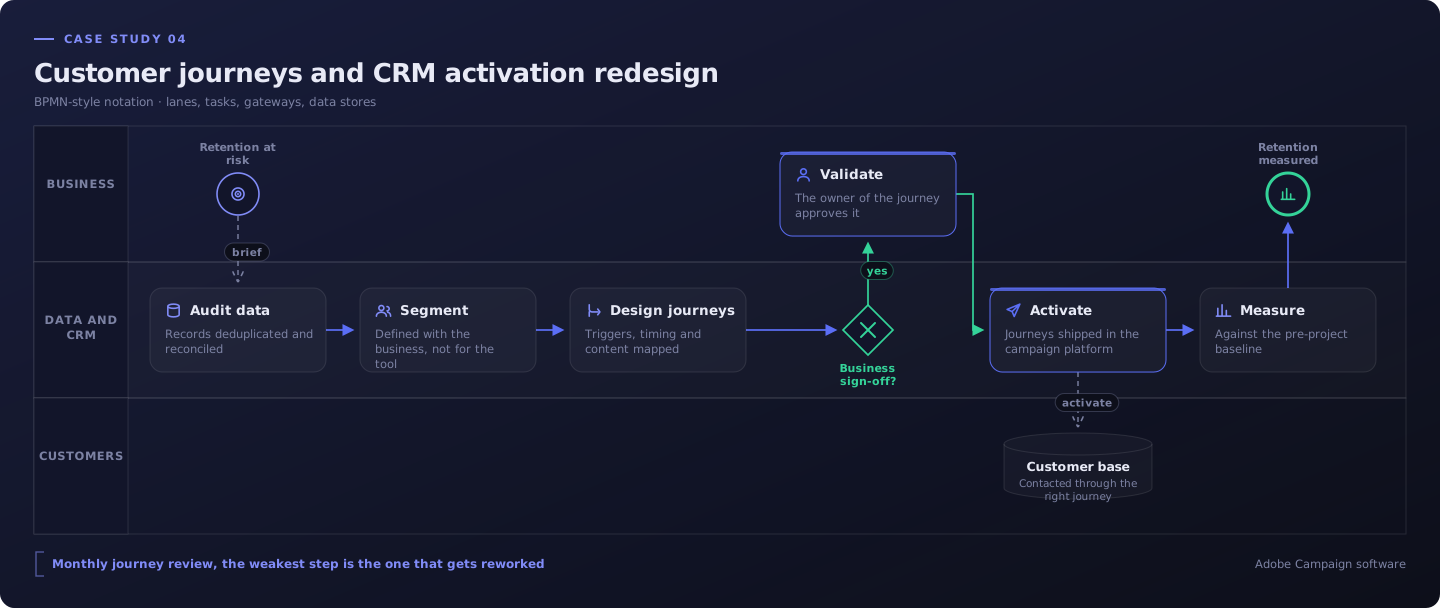
The customer database is cleaned up first. Only then do three groups get three different messages.
- 3 groups defined by the business, not by the tool
- Clean data, cleaned before the first send
Before and after
The starting point
A customer database decays on its own. Duplicates pile up. Addresses go out of date. Segments created three years ago no longer match anyone.
Yet campaigns keep being sent to it. And people are surprised that results go down.
What was put in place
Look at the data
First, look at the data before talking about campaigns. Records are audited, duplicates removed, sources reconciled. It is the thankless part. Without it, everything else is wrong.
Define groups with the business
Then, define groups with the business, not with the tool. A group that exists because the tool can compute it is useless. A group that matches a situation the business can describe gets results.
Build the journeys and measure them
Finally, build the journeys and measure them. Who gets what, when, and why. Then compare with the starting point, not with a hunch.
You stay in controlGroups are defined with the business, and every journey is compared with the starting point, not with a hunch.
The result
+5% customer retention.
What it taught us
Data quality decides the result, long before how sophisticated the tool is.
How it works