Rolling out a brand website across 20 markets
The site is built once, centrally. Each country adapts it to its own rules. Twenty teams, one delivery.
- -10% bounce rate, measured country by country, not on average
- One common base: one central build instead of twenty
Before and after
The starting point
Stellantis launches the redesign of its brand website across twenty countries. The principle is set from the start: a platform built centrally, and an adaptation made by each country.
On paper, it is the right choice. In practice, it is the setup that creates the most friction, because both sides are right.
The centre wants one single, consistent base that is easy to evolve. Each country wants its exception, and often has good reasons. A Hungarian legal notice is not up for negotiation. An Argentinian catalogue has nothing to do with a Japanese one. And a local team that is not listened to does not test, it blocks.
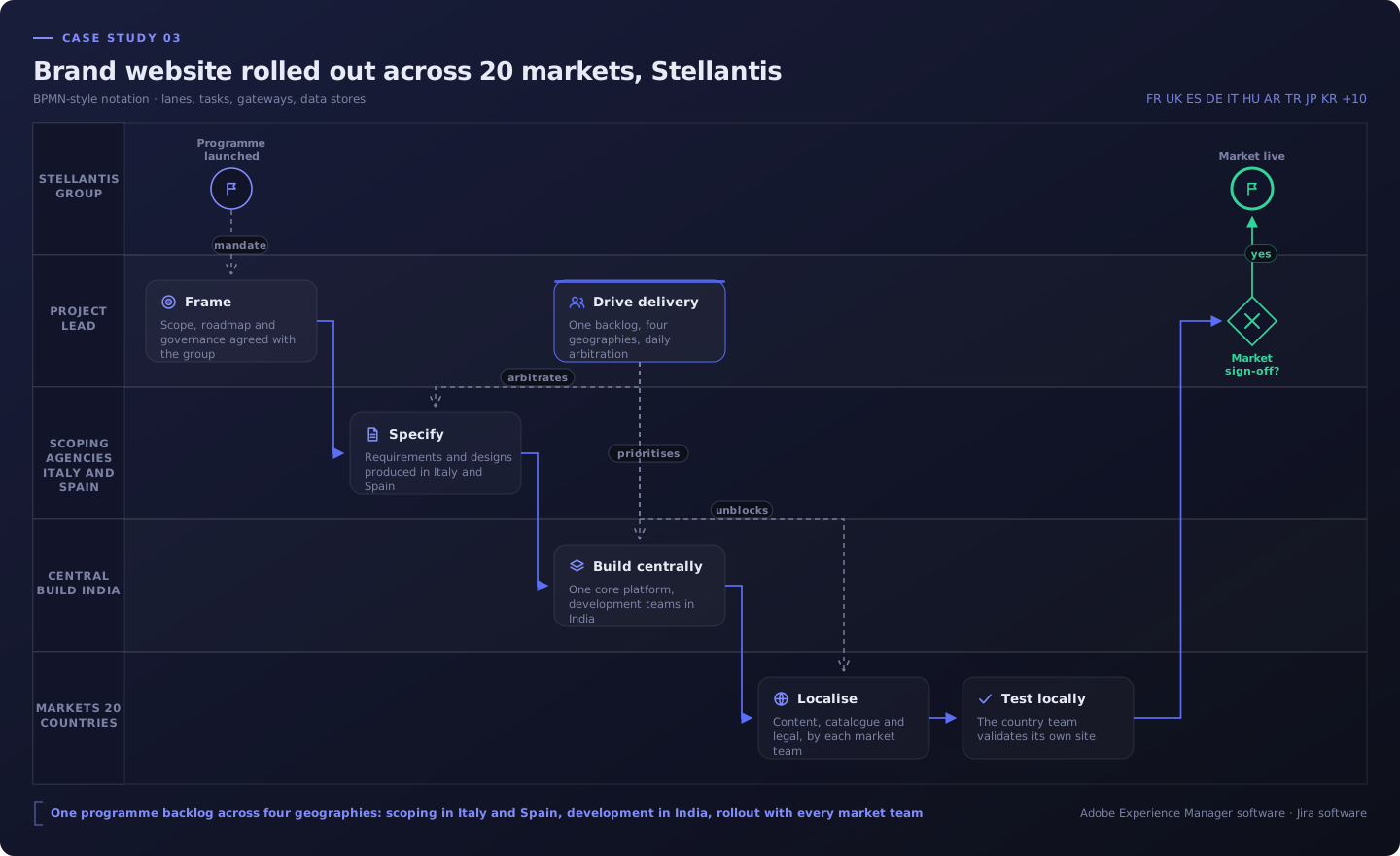
On top of that came distance. Scoping was done by agencies in Italy and Spain. Development by teams in India. Rollout by teams spread around the world. Four time zones, four ways of working, one delivery.
What was put in place
One single backlog
One single backlog. Not a central backlog plus twenty local ones. Just one, where country requests come in at the same place as the brand’s and are prioritised by the same rules. A local team can no longer bypass the process. In return, it has to state its need instead of demanding it.
Specifications written before adaptation
Specifications written before adaptation. Agencies produce the requirements and mockups. Development teams build the base. Country variants come afterwards, on something stable. The reverse order never converges.
Acceptance testing by the country itself
Acceptance testing by the country itself. No site goes into production until its local team has signed it off. It is slower on paper. It is faster in reality, because you do not fix twenty sites at once after the fact.
Decisions every day
And decisions every day. This is the part that shows up on no plan: deciding each day what goes through and what waits, between an agency in Milan, developers in Bangalore and a team in Tokyo.
You stay in controlNo site goes into production until its local team has signed it off.
The result
+15% traffic in the first quarter after launch, and -10% bounce rate. Figures were tracked country by country. That made it possible to spot the three markets that were falling behind and handle them separately.
What it taught us
A rollout across several entities is not won on technology. It is won on how much room is left for local exceptions. Too little, and teams work around it. Too much, and the common base falls apart.
It is exactly the same work when a company wants to automate a process shared across several branches or subsidiaries.
How it works